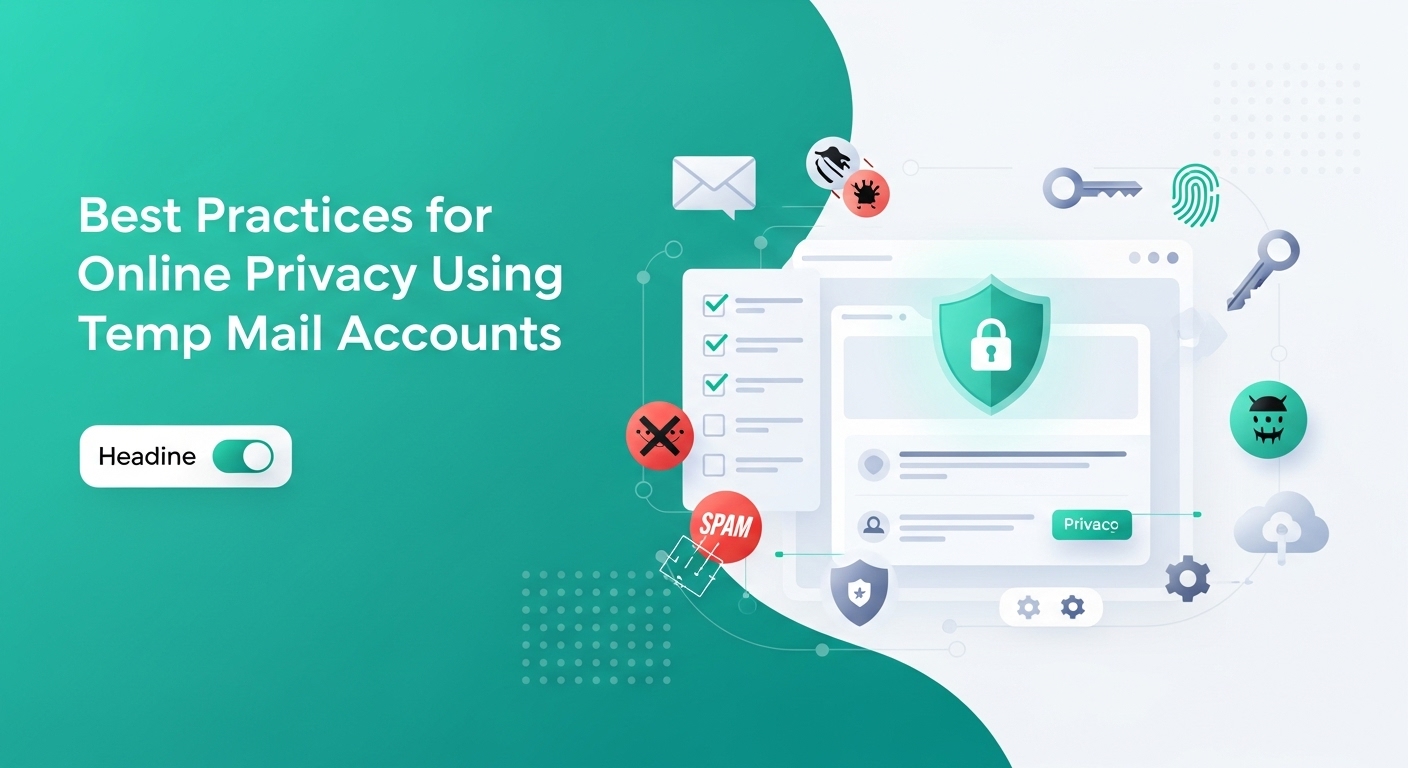
Best Practices for Online Privacy Using Temp Mail Accounts
What are Temporary Emails?
Better known as temporary email accounts or disposable emails, temporary emails help those valuing their privacy conceal themselves when going through everyday online tasks. Using temporary emails allows users to receive emails without compromising their email address, but only for brief periods. The main objective of temporary emails is to safely provide users with an email address that allows them to log on to different services, funnels, or registrations without revealing their identities.
Temporary email accounts are pretty straightforward. To start out, users have to visit a site that is typically a service of temporary email accounts, at which point, an email address is generated for them. Any emails that are sent to that address are queued on their server for them to see. This way, users get to see the emails without having to create an account, which is a quick and straightforward way to achieve their privacy goals and minimizes the subscription emails.
Temporary email accounts have a multitude of benefits. For one, they provide relatively better email protection by changing the email that the spam email is sent to. The users of temporary emails are also pretty safe from phishing emails since users do not have to provide their email accounts which are usually speaking. Finally, temporary emails accounts are very useful when signing up for a new online service that a user is interested in.
However, using temp mail accounts also has some disadvantages. Probably the most noticeable, the account lifespan of most temp mail accounts is short. Many delete emails after a certain time. This means if you need to access information later, you might not be able to. With a lack of strong encryption, some of these accounts pose a security risk. The confidentiality of the messages may still be at risk. Users of these accounts need to realize that these accounts are not suitable for every situation. temp mail accounts can be a helpful way to stay private online.
Understanding When to Use These Accounts
In a few different situations, temp mail accounts can be a good way to stay private online. The main goal of these accounts is to provide an email that can be used to sign up for online purchases, accounts, free trials, etc. while still keeping the user's private email private. It can also be helpful for avoiding spam emails. This email can help avoid any possible data breaches that can occur due to email listing. The more you know about using temp mail, the more you can protect yourself online.
A good use case of temp mail accounts is to use them to sign up for online services and platforms. Many sites the use of a personal email to complete an account creation. This can expose users to a greater risk of low quality marketers and spammers. At the same time, this can be an effective way to limit access for low quality marketers to customers. It's especially beneficial for trials to test a service without providing a permanent email.
Also, temp mail accounts are quite handy for collecting materials such as e-books, whitepapers, or trial software versions, which are sometimes offered for free Downloading these resources usually requires an email address, but with temp mail, you remain private while receiving the materials. The same goes for online forums When entering discussions or seeking support, you have the option to leave your real name out of the equation. A temp mail offering privacy and anonymity is your best option.
If you like to buy stuff online or get to internet’s respectfully private places or in the case of sensitive proprietary content, privacy becomes a bigger cause. In case of poor online security or in platforms with proliferation online or phishing mechanisms, tools which target your poor online security by attacking your online traffic and thereby exposing your tools to the real world substantially, a temp mail offering boosts your own personal security and privacy up to a dare while offering you online safety from other people’s online mechanisms. In short, it is wise to get a temp mail especially whenever you are worried about your privacy and security online.
Temp Mail Services: What to Look for
When you are considering the use of a temp mail service, you also should consider the service is providing a support for your privacy. You should consider several other things. First is the design of the UI, or the interface. A simple but elegant UI adds to the level of comfort of service provider.
Temporary emails' expiration date is also important as emails that are for time limited communication need to maintain that time limit and for emails that require the user to click on a link to verify a process need to be time flexible as they need to remain for the user to click on the link and for the user to verify that process.
An important factor is temp mails' anonymity. Use a service that does not require the user to put down info on the user; this can lead to the service compromising the user's privacy. Use service providers that have the option of having their info not be collected and having no activities be tracked.
Lastly, look at what other features are being offered. Providers that offer services that give you a disposable phone number are ways that can enhance your online safety as well .
Best Practices for Managing Temp Mail Accounts
Managing temporary mail accounts is important when it comes to their online safety and their online temporary safety. For example, an important practice is to maintain the practice of changing temporary emails as it can reduce the user being linked and most importantly it reduces the number of spam and phishing attempts.
Knowing the lifespan of a temporary email address is no small matter. Knowing the limits on the lifespan of these addresses is not an easy matter. It can take an address from a matter of minutes to a matter of days. Due to the added pressure of the short lifespan it is unwise one trusts the information to a temporary email address that cannot be deleted. For long term sensitive information one should not trust a temporary email address.
It is also unwise to use your temporary email address while engaging in sensitive and personal information. Especially it is unwise to use sensitive information for something that requires a payment method or long term access. For long term expensive information, or for short term information to keep access and control of the information use your main email.
The use of a temporary email address comes with a short list of common tech issues. A short list of common issues includes not receiving an email or a confirmation email. To resolve one of such short list issues it is unwise to use your temporary email address. One should also use temporary email addresses from temporary email vendors use.
To such an end temporary email vendors promise excellent privacy policies. To such an end temporary emails serve the same excellent end. Using the same temporary email address to use to use a temporary email address is. We also end the same temporary emails. To such end use the same temporary email address.