How Temp Mail Works: Technology Behind Disposable Email
Temporal Email Services Explained
Temporal email services are changing the game for email users that want to prioritize their online safety. Using disposable emails adds a new form of anonymity to online interactions. Users create an email that lasts only for a specific duration to use when signing up for online services. Once the email time limit is up, the email and all of the email service's tracking information will be removed. Therefore, this protects the email user's personal and most likely primary email from online tracking through websites that require emails to sign up and subsequently spam users. In a time period of aggressive data collection through breaches and an overload of spam, this is a critical solution to data privacy and protection.
Because of the increase in want for online protection, all of the temporal email services will continue to increase in relevancy. Providing a primary email is increasingly seen as more and more risky, and temporal email services are a great alternative for online services that require emails. Email spammers and phishers are a true threat to data safety, and this will continue to be an issue. Temporal emails are the first line of defense for users that want their primary email data to stay private, but still want to access online services that require email sign up.
Temp emails are used to sign up for subscriptions and things like forums and trials without revealing your real email. You can use these emails to interact with websites without worrying about spam or compromising your personal information. They are great for trying new websites to avoid spam in your regular inbox.
How Disposable Emails Work
Disposable emails use new technology to offer temporary emails. These emails are typically live for a few minutes to a few days. These emails offer users privacy by giving out an email other than your personal email for spam signups and other promotions.
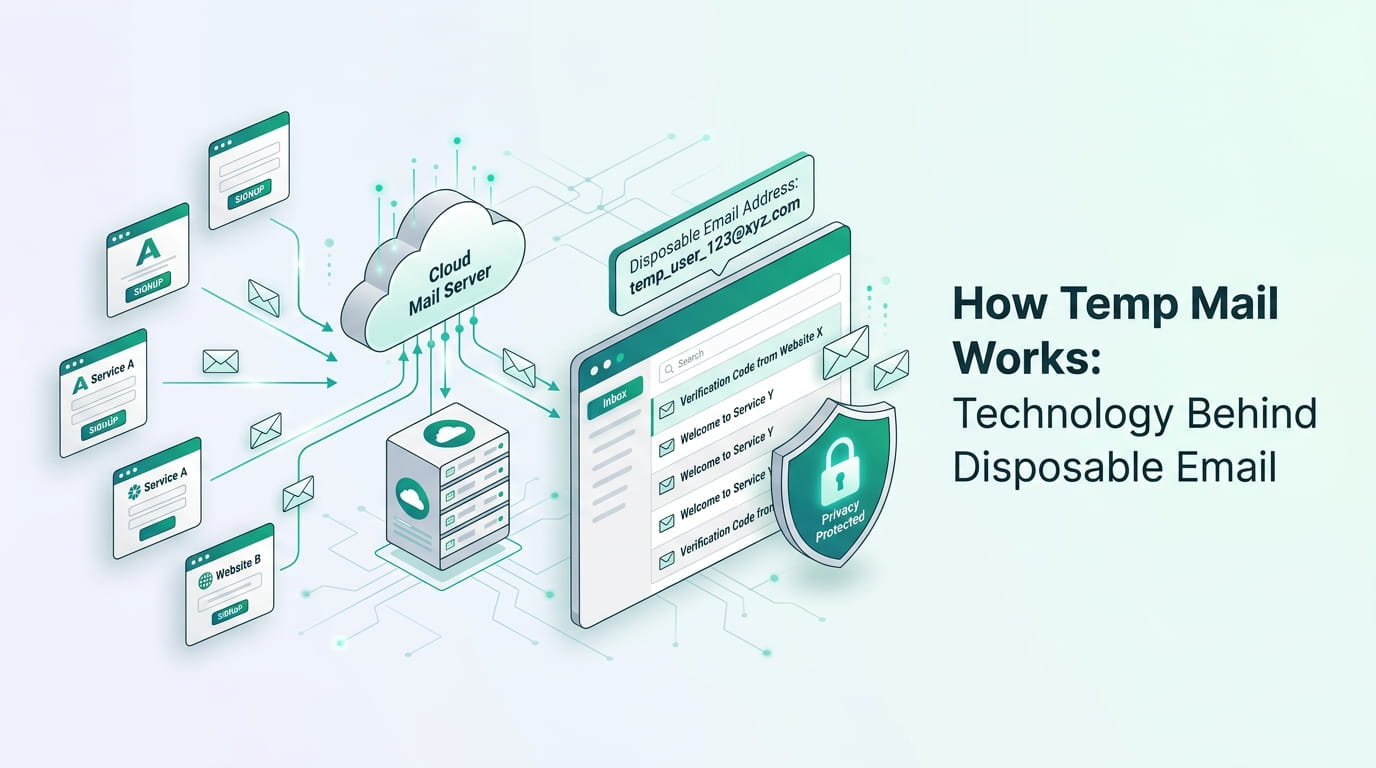
The technology behind disposable emails starts with the temporary emails. These emails are created by the service after a user decides to make a temporary email. They are made with the service's domain and have random letters or phrases. This email address expires and future emails cannot be received by it.
After creation, all emails sent to this temporary address quickly go to the disposable emails server thanks to the Simple Mail Transfer Protocol (SMTP). SMTP is responsible for setting up an SMTP connection between the user's email server and the disposable email server. In the case of temporary emails, the SMTP connection between the sender's email server and the disposable email server can employ certain extensions of the protocol to filter what to let through SMTP, which can be useful for preventing complexity, administrative burden and to some extent, phishing, or spam of unsolicited email messages.
A key thing about disposable emails is that they are temporary. Depending on how the service is designed, the address can be left active for a certain period of time, or switched off for a certain time and left inactive, or switched off indefinitely. Once an address is inactive, for the duration of the time for which an address is inactive, or forever, the emails and messages are purged to make sure that they are inbound messages. The address, the messages, the entire self-contained unit, and time of the address make the services. In relation to temporary email services, the self-contained unit that contains the time, the messages, the address serves to resolve for those that the time be auxiliary.
Utilizing a temporary email address has several benefits, particularly in the current age of technology. Most importantly, disposable email addresses greatly improve the user's privacy. Their primary email address is protected from potential breaches and misuse, and they can receive communications from services like newsletters. Additionally, users can safely interact with a multitude of online services without the fear of their information being compromised.
One very important benefit is how these emails help reduce spam and unwanted emails. A spam email would be a big wall of unwanted emails where all ads and promotional emails would get stuck. With a temporary email address, users get spam emails only for the unimportant ads. Using a temporary address for sites that send emails that users wouldn’t want will help users maintain a clean main email inbox. This helps users avoid spam emails and Phishing emails that would probably try to steal information by leading users to fake places. Spam emails infiltrating primary inboxes are annoying. So, temporary addresses help users avoid signing up for new services.
Personal emails to fake addresses help users avoid services that require temporary email addresses. A perfect example is websites that require users to enter their email addresses to gain entry, and afterwards, users are most probably not interested in returning to that website. This mainly applies to websites that are preferring mainly to up-and-coming promotions, new software that is free, free trials, etc. This helps avoid emails for events that are related to the new software and new promotions. Also, this helps avoid emails regarding unsolicited services getting to inboxes as it helps avoid future email services for example software installs which would help avoid related ads from getting to inboxes.
Using emails to sign up for services can help avoid emails for new unsolicited services. This helps avoid spam emails, and helps maintain privacy when it helps maintain privacy regarding unsolicited communications.
Using Temporary Mail: Limitations and Best Practices
Temporary email has many advantages and clear disadvantages. First, account recovery. Due to how quickly these accounts can be removed and regenerated, these emails often don’t successfully recover accounts. Loss of access to accounts temporarily mail was utilized on can be a knock to productivity.
Reliability of service is also a point of concern. Unreliable service is common across these products in the form of unintended downtimes. Falling victim to an undelivered critical email because of a temporary email is a situation best avoided.
Temporary emails services also come at a not-so-hidden security risk. For as long as the domain name remains, the emails are at an even greater risk of spam and other unwanted emails. Due to a lack of security, information may at the very least become common knowledge to anyone in the pages of the emails interchanged.
To properly enjoy the benefits of temp mail while minimizing the risk associated with inappropriate temp mail usage, one must best practices. This includes choosing a provider that is reliable and goes beyond the minimal of data security to protect your data. Above all, naive temp mail uses must use these systems while fully understanding the risks of using an unverified provider should things ever go wrong.
In conclusion, temporary emails are great for cutting back on spam and protecting a person's identity, but they must be used for the right reasons. Keeping in mind the limitations and risks of spam emails, private emails can be used as effective tools to enhance indiviuduals' privacy and improve temporary emails services as a whole.